The challenge
A support team that is scaling fast needs agents who can talk customers through installation problems without a physical kit to train on, and without support quality slipping.
A 15–20 minute computer-based training module for new Tier-1 support agents. It moves from how the signal chain works to a live troubleshooting conversation, with practice and feedback at every step.
← Explore all projects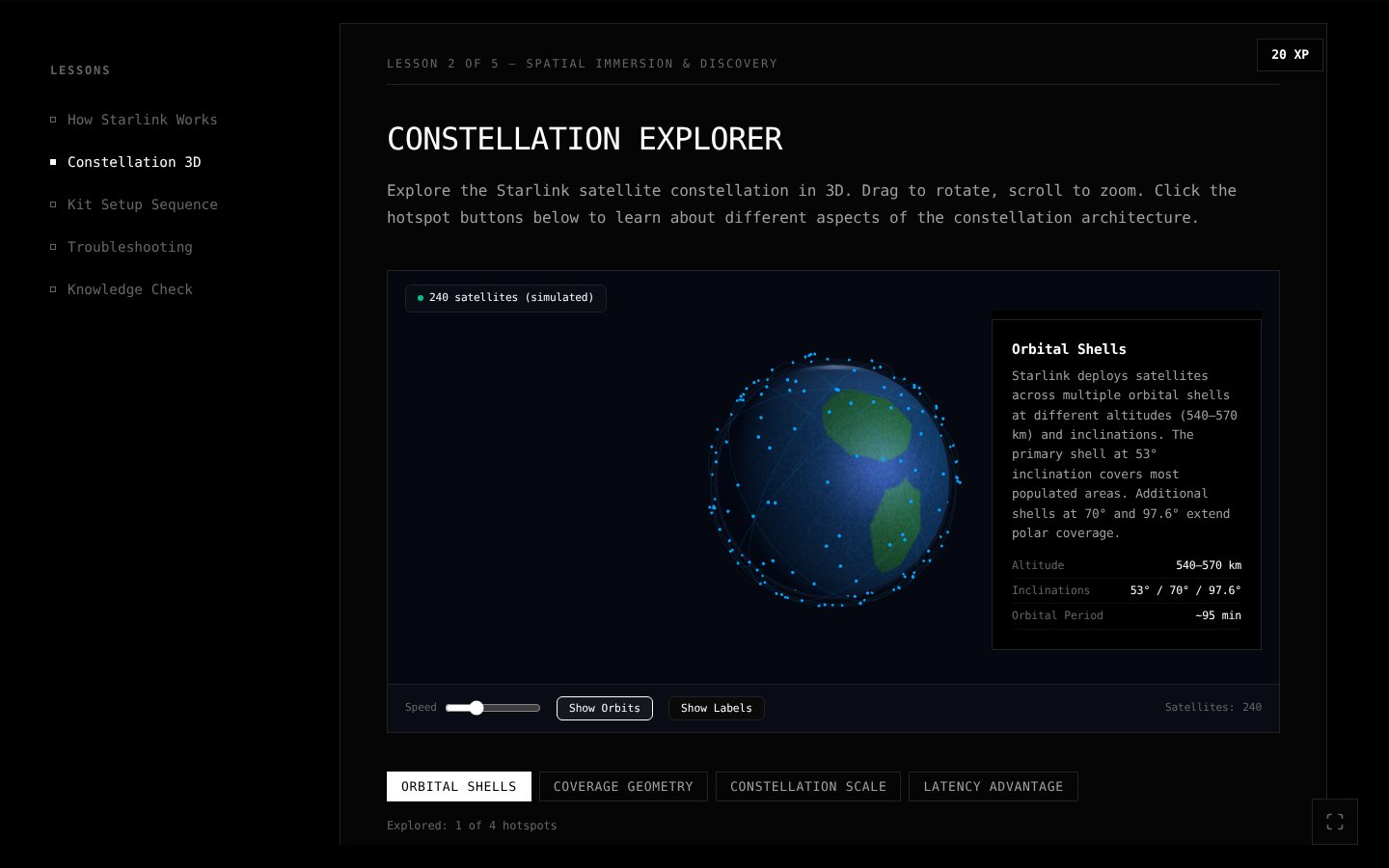
A support team that is scaling fast needs agents who can talk customers through installation problems without a physical kit to train on, and without support quality slipping.
Task-centred, scaffolded practice. Agents build a model of the system, see it in 3D, put the setup in order, then handle a customer conversation, with immediate corrective feedback on every choice, including the tempting wrong ones.
A correct setup sequence, diagnostic choices in a live scenario and knowledge-check answers, with experience points tracking progress.
I designed and built the module as an independent portfolio piece.
This is an independent demonstration, not affiliated with Starlink or SpaceX. No employment, client relationship or measured performance gains are claimed. The design targets were to halve time-to-proficiency from ten days to five and to cut escalations by 30%; these are targets, not results.
Each lesson uses a different kind of practice.
Explore and discover: click through the signal chain from satellite to dish to router to device, and see why knowing where a fault sits matters.
Rotate and zoom a simulated 240-satellite constellation, with hotspots on orbital shells, coverage, scale and latency.
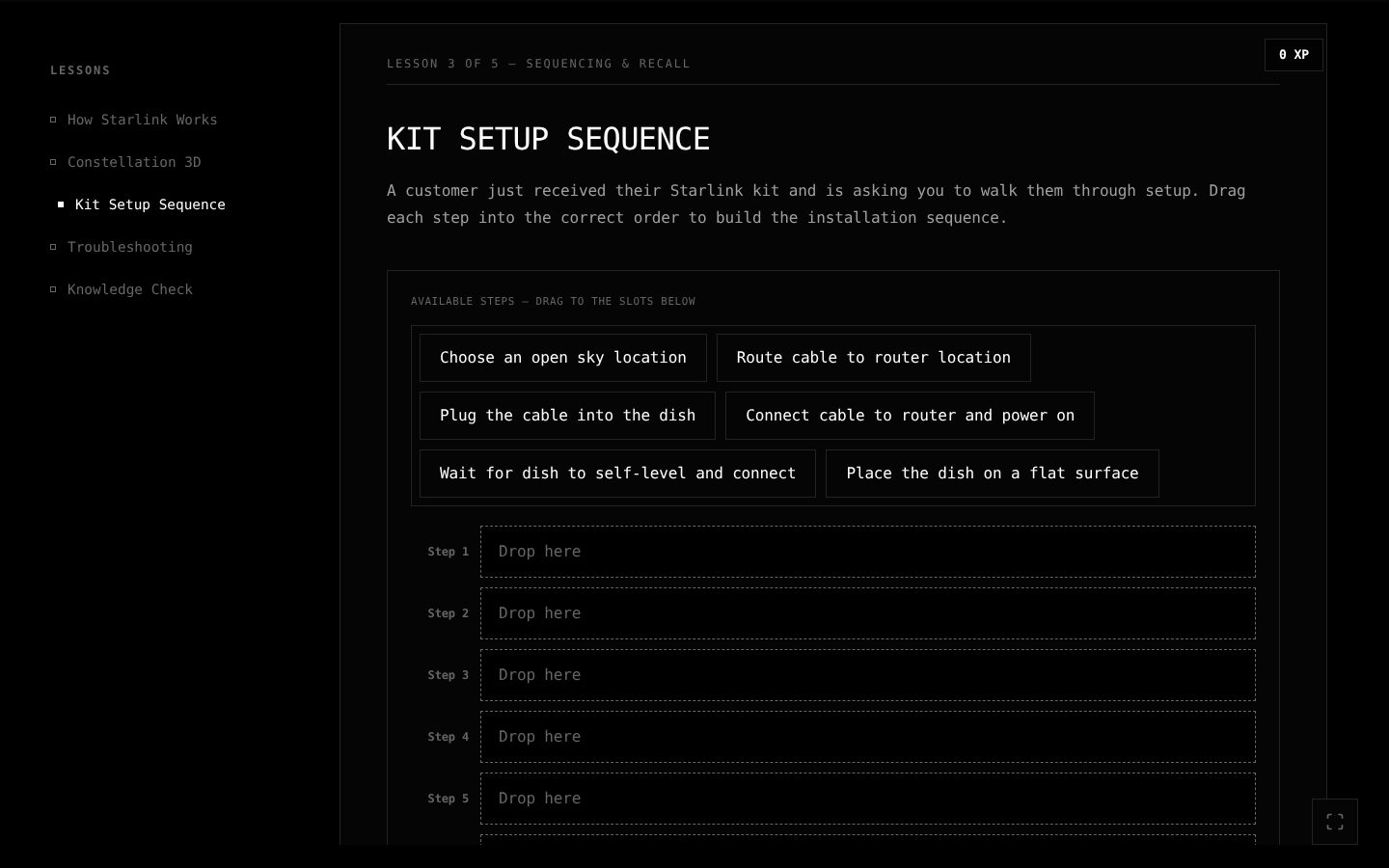
Sequencing and recall: drag the installation steps into the right order.
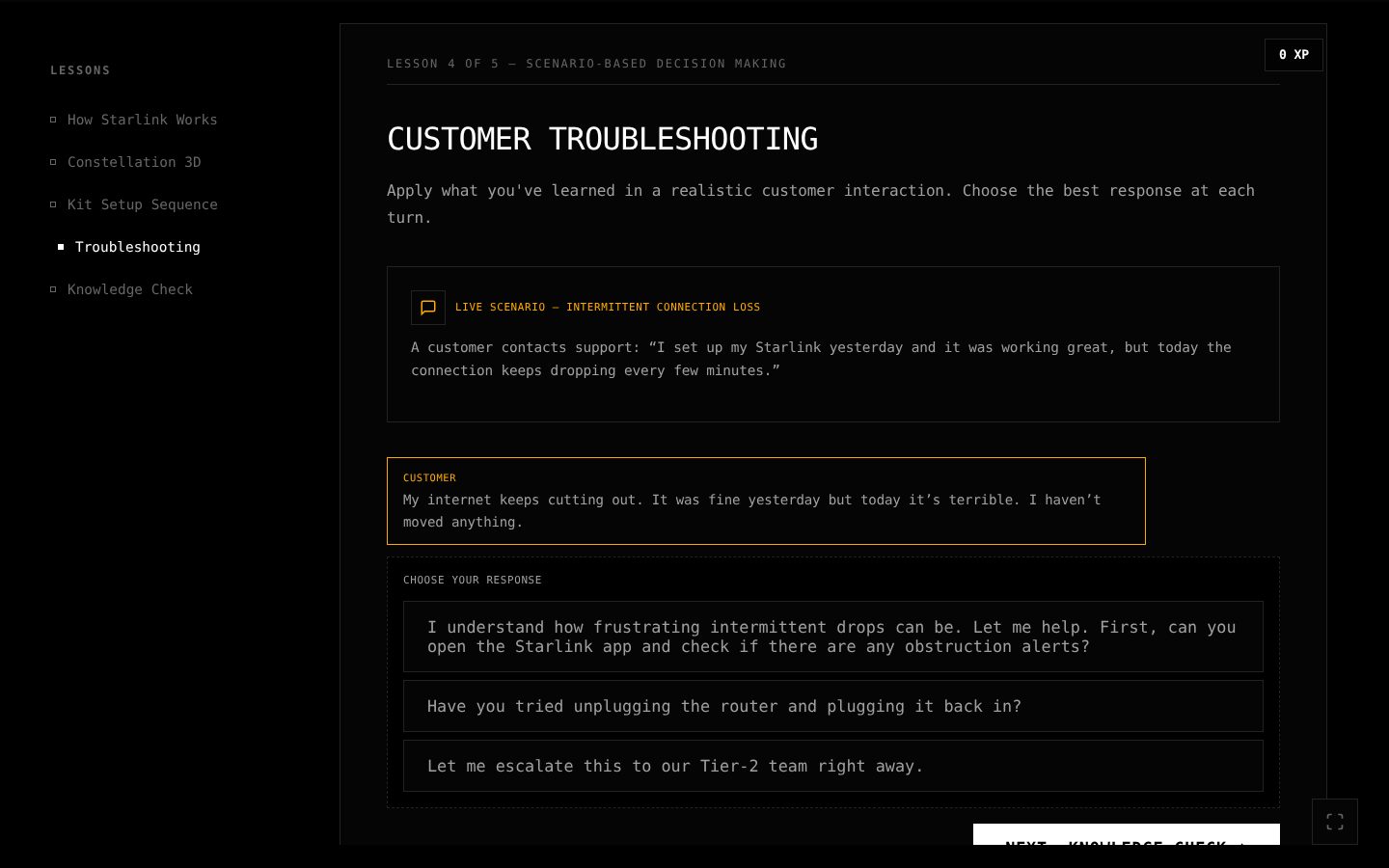
Scenario-based decisions: choose a response at each turn of a customer conversation and get feedback on every option.
Three questions to confirm the essentials before the agent moves on.
The module trains agents to diagnose before they act.
| Decision | What it trains | In the module |
|---|---|---|
| Start from the signal chain | A mental model to diagnose from. | Agents explore each link in the chain and why knowing where a problem sits leads to the right questions. |
| Make the invisible visible | Understanding orbit, coverage and latency. | A 3D globe of 240 simulated satellites, with orbits that can be shown and four hotspots to explore. |
| Sequence before troubleshooting | Recalling the procedure customers will ask about. | Drag-to-order setup steps. |
| Practise the conversation, not just the facts | Applying knowledge where it’s actually used. | A customer reports intermittent drops, and the agent picks each response. |
| Feedback on every option | Learning why a tempting answer is wrong. | Escalating straight to Tier 2 is flagged: it lengthens the customer’s wait and overloads the next tier. |
| Diagnose before replacing | Resisting the costly default. | An obstruction alert points to placement, not hardware, so a replacement order is flagged as wasted effort. |
The module is complete and playable in the browser as a portfolio demonstration.
It hasn’t been used with real agents or an employer, so there are no learner results, and the time-to-proficiency and escalation targets are untested.
Learning strategy, institutional systems and decision practice.