The challenge
Complex simulations are hard to coordinate, document, assess and repeat. A seminar game with senior decision-makers, student role-players and a White Cell generates decisions and trade-offs that disappear if they only live on paper.
A digital operating environment for statecraft simulation. Plenum runs the roles, teams, injects, decisions and records of a live exercise, so a one-off event becomes something that can be repeated and studied.
← Explore all projectsComplex simulations are hard to coordinate, document, assess and repeat. A seminar game with senior decision-makers, student role-players and a White Cell generates decisions and trade-offs that disappear if they only live on paper.
Structure the environment rather than the game: seats for teams and roles, injects, decision submissions, adjudication and records, all driven by a scenario pack that can be swapped for the next exercise.
A complete record of each session, action by action, for after-action review and for research on how leaders make decisions under pressure.
I lead Plenum’s conceptualisation, design and development as AidData’s partner to the Statecraft Simulations Group, and I train the student team in playtesting, facilitation and the platform’s workflows.
The Statecraft Simulations Group’s inaugural simulation, held at the William & Mary Washington Center in Washington, D.C., and led by General Charles Lyon (USAF, Ret.). Senior government, NGO and business leaders acted as decision-makers, with William & Mary undergraduates in key roles. Plenum supports its preparation and delivery.
The same sequence for every scenario pack.
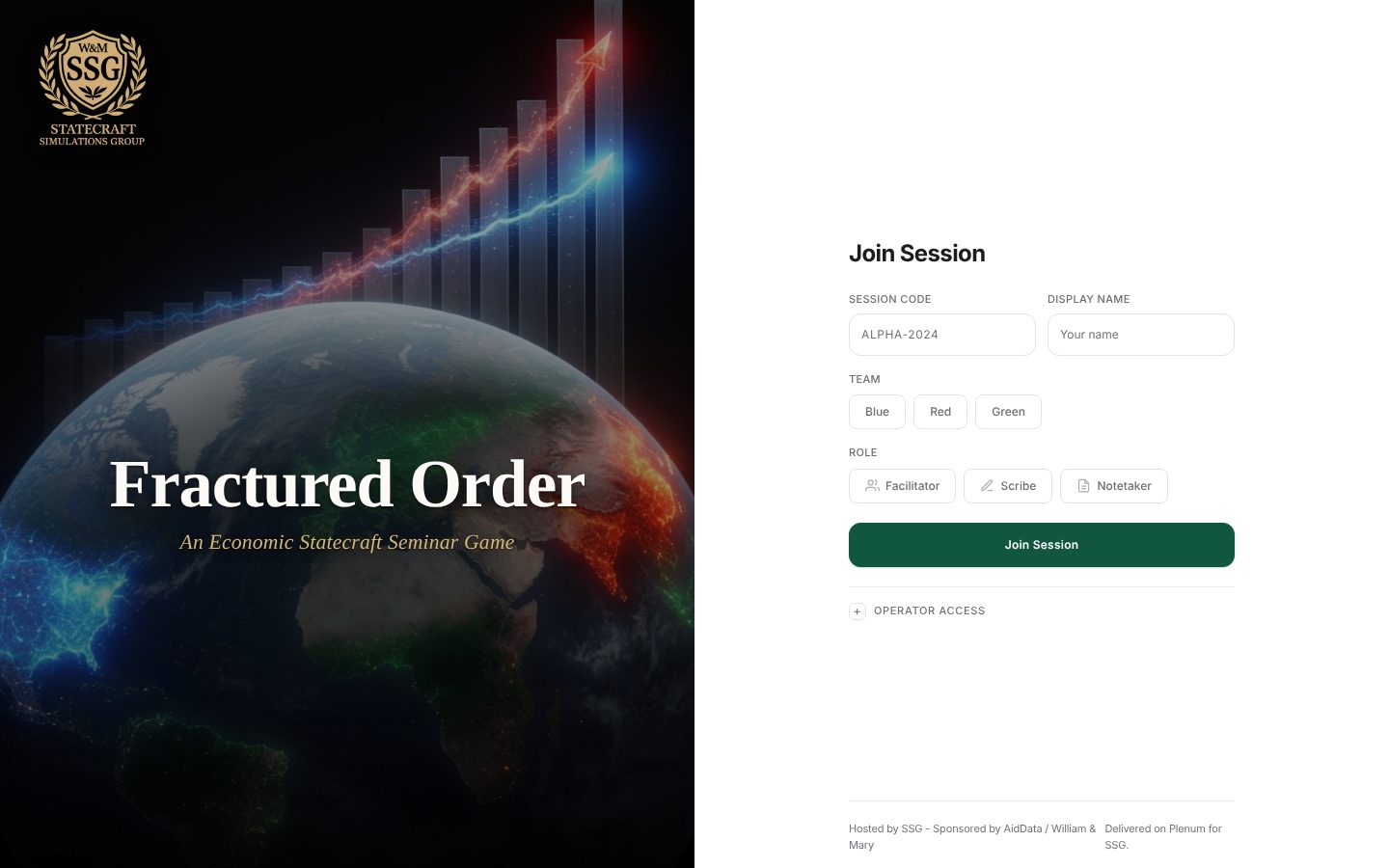
Participants join with a session code and take a seat: a team and a role such as facilitator, scribe or notetaker.
The operator moves the session through moves and phases, and scenario materials and injects arrive from the active pack.
Teams submit actions, proposals and requests for information instead of free chat.
The White Cell responds to requests and adjudicates proposals. Responses lock once they are finalised.
Every action, proposal and request is logged, and operators can export the session data.
Facilitators reconstruct the session for the after-action review, and researchers analyse the decisions.
Plenum is built so that facilitation stays manageable and the record stays complete.
| Decision | What it enables | In the platform |
|---|---|---|
| Scenario packs, not hard-coded games | Reusing one platform across different exercises. | The runtime loads the active scenario pack and falls back to the built-in Fractured Order pack. |
| Seats by team and role | Clear authority and accountability in play. | Participants claim a seat, a team plus a role, when they join a session. |
| A White Cell built in | Consistent adjudication. | The White Cell has its own role and permissions in the backend, separate from the teams. |
| Structured submissions | Making reasoning visible. | Actions, proposals and requests for information, with proposal responses locked once finalised. |
| Records by default | After-action review and research. | Activity is logged as it happens and can be exported for analysis. |
| An operator console | Running the room at a glance. | Live counts of sessions, participants, actions and pending requests, with move and phase control. |
AidData’s account of Fractured Order describes Plenum as the platform for the group’s simulations and names me as leading its design and development. The platform supports the game’s preparation and delivery, and the student team trains on it.
Plenum is still in development and user testing is ongoing. Decision analytics and after-action dashboards are planned rather than built, and no evaluation of the platform has been published.
The live session entry for the Statecraft Simulations Group’s seminar game
AidData’s account of Fractured Order and Plenum
Learning strategy, institutional systems and decision practice.