You are Amara, a Zimbabwean smallholder with two tonnes of tomatoes, $480 in your jacket lining and a buyer waiting in South Africa. You have never heard of the AfCFTA. Getting through Beitbridge shows you why that matters.
Trade policy practitioners, AfCFTA programme staff and people building African SME capacity
Format
Single-player branching story; six checkpoints; capital, time and losses tracked on screen; several endings
Grounded in
My 2026 African Liberty article, “The Distinction Africa Must Make to Unlock the AfCFTA”
Built with
HTML, CSS and vanilla JavaScript; static, with no build step; keyboard and screen-reader support
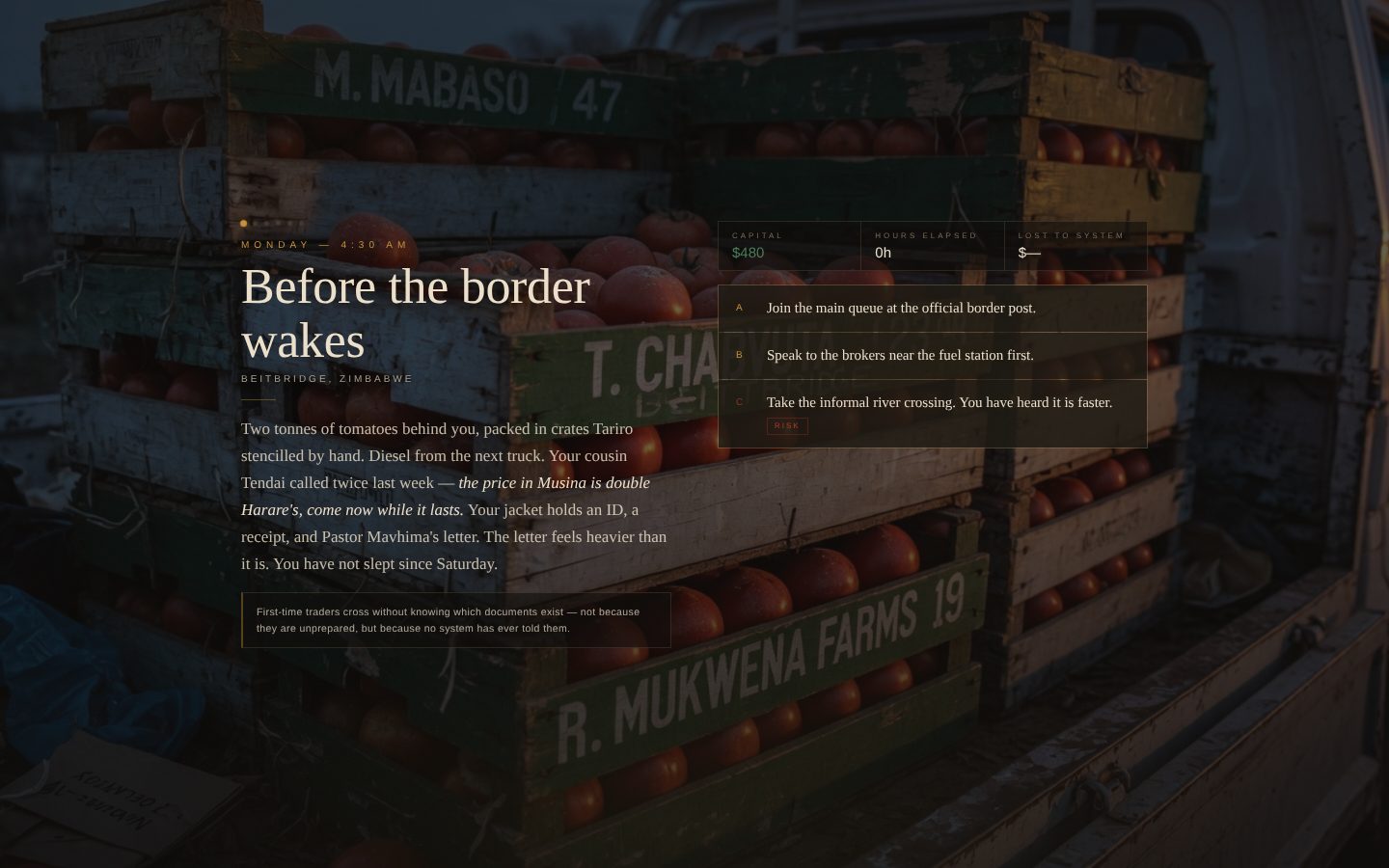
Before the border wakes: three routes, and $480 that isn’t all Amara’s.
The design problem
The challenge
The AfCFTA has built the legal capacity for intra-African trade, yet fewer than 20% of African SMEs have ever tried to export. The barrier is capability: knowing how to move goods through documents, levies and delays. That gap is hard to convey in a policy brief.
The logic
Make the gap between capacity and capability something the player lives through. Every decision point encodes a documented non-tariff barrier, money and hours drain as the player goes, and the policy tools only appear at the end, once the player can see what knowing them in advance would have saved.
What players take away
The difference between rules that exist and the knowledge needed to use them, plus the specific tools: the SADC Certificate of Origin, the AfCFTA e-Tariff Book, the Guided Trade Initiative and the Non-Tariff Barrier Online Mechanism.
My role
I wrote, designed and built Beitbridge as a companion to my published argument on AfCFTA capacity and capability.
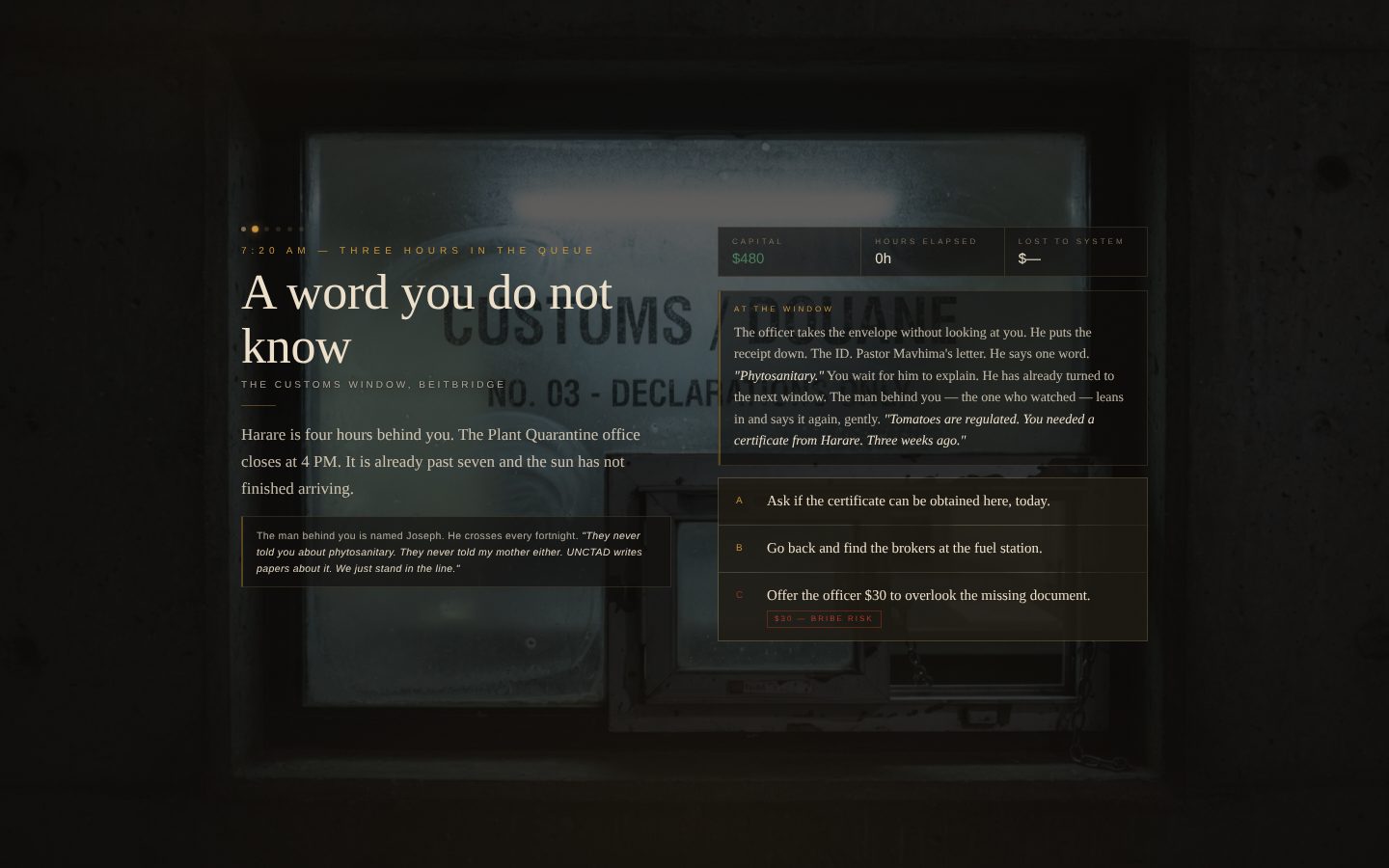
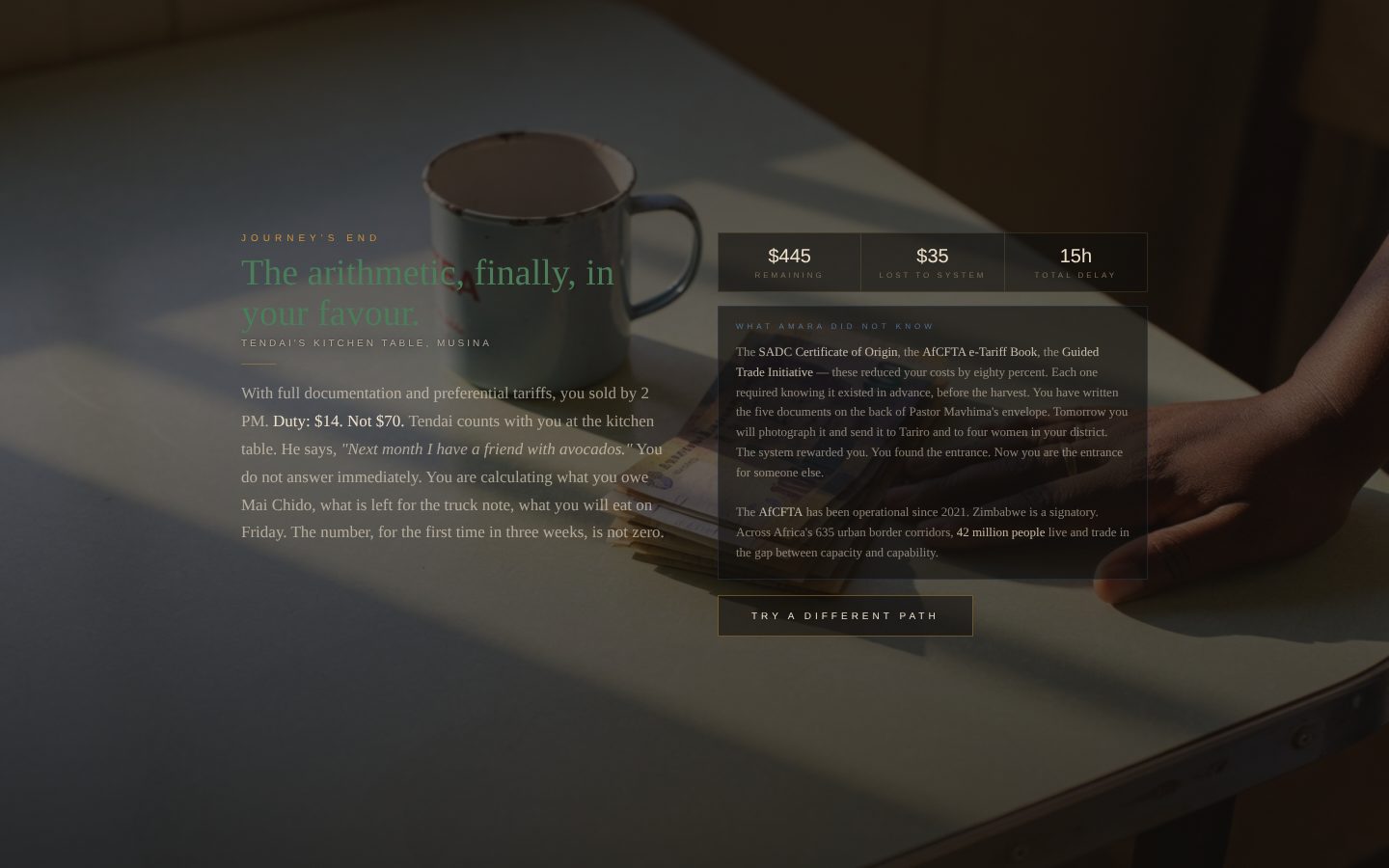
Inside the storyAt the customs window, the bribe option shows its cost and risk before you choose it.Journey’s end on the documented route: $445 left, $35 lost to the system, 15 hours of delay, and what Amara didn’t know.
How a run plays out
Choose, pay, wait, learn.
Each route runs through up to six checkpoints, and each one has a price.
01
Start with what you carry
$480: half borrowed against a neighbour’s stokvel and owed back on Friday, a third for the truck note, the rest yours.
02
Pick a route
The official queue, the brokers at the fuel station, or the informal river crossing someone said was faster.
03
Meet the barriers
Documents nobody mentioned, broker fees, duties and offers to look the other way, each costing money, hours or both.
04
Live with the outcome
Routes end in a formal warning and a lost day, confiscation, a softened load sold cheap, or, on the documented route, a sale.
05
Learn what existed
The ending names the tools that would have cut costs by eighty percent, and notes that the Non-Tariff Barrier Online Mechanism had 1,911 registered users across 54 nations.
06
Try a different path
Replay from the start to compare routes and what each one cost.
Design decisions
Every mechanic has a job.
The story turns trade statistics into one person’s Monday morning.
Decision
What it trains
In the story
A named trader with borrowed money
Feeling what a lost hour costs a small trader.
Half of Amara’s $480 belongs to a neighbour and is due on Friday.
Every choice encodes a documented barrier
Recognising non-tariff barriers as they appear.
A phytosanitary certificate nobody mentioned until the window, broker fees and unofficial levies.
Money and time on screen
Seeing costs build up, not just the total.
Capital, hours elapsed and losses to the system are tracked at every checkpoint.
Choices that lock
Treating constraints as real limits.
Choices Amara can’t afford are locked and can’t be activated by keyboard or pointer.
Delay the policy reveal
Valuing information by what its absence cost.
The AfCFTA tools appear only at journey’s end.
Replay
Comparing routes and outcomes.
“Try a different path” returns to the start.
Accessible by default
Reaching readers on any device.
A skip link, focus that moves to each new scene, live-region announcements and reduced-motion support.
Evidence
What’s documented
The prototype is complete and publicly playable, published alongside the African Liberty article it puts into practice.
Limits
What the evidence can’t show
Beitbridge hasn’t yet been run with traders or trade officials, so there’s no evidence yet of what players learn from it. It follows one trader through one border corridor.