| An African Union envoy, not an outside power |
Seeing the crisis from the institution that holds the mandate. |
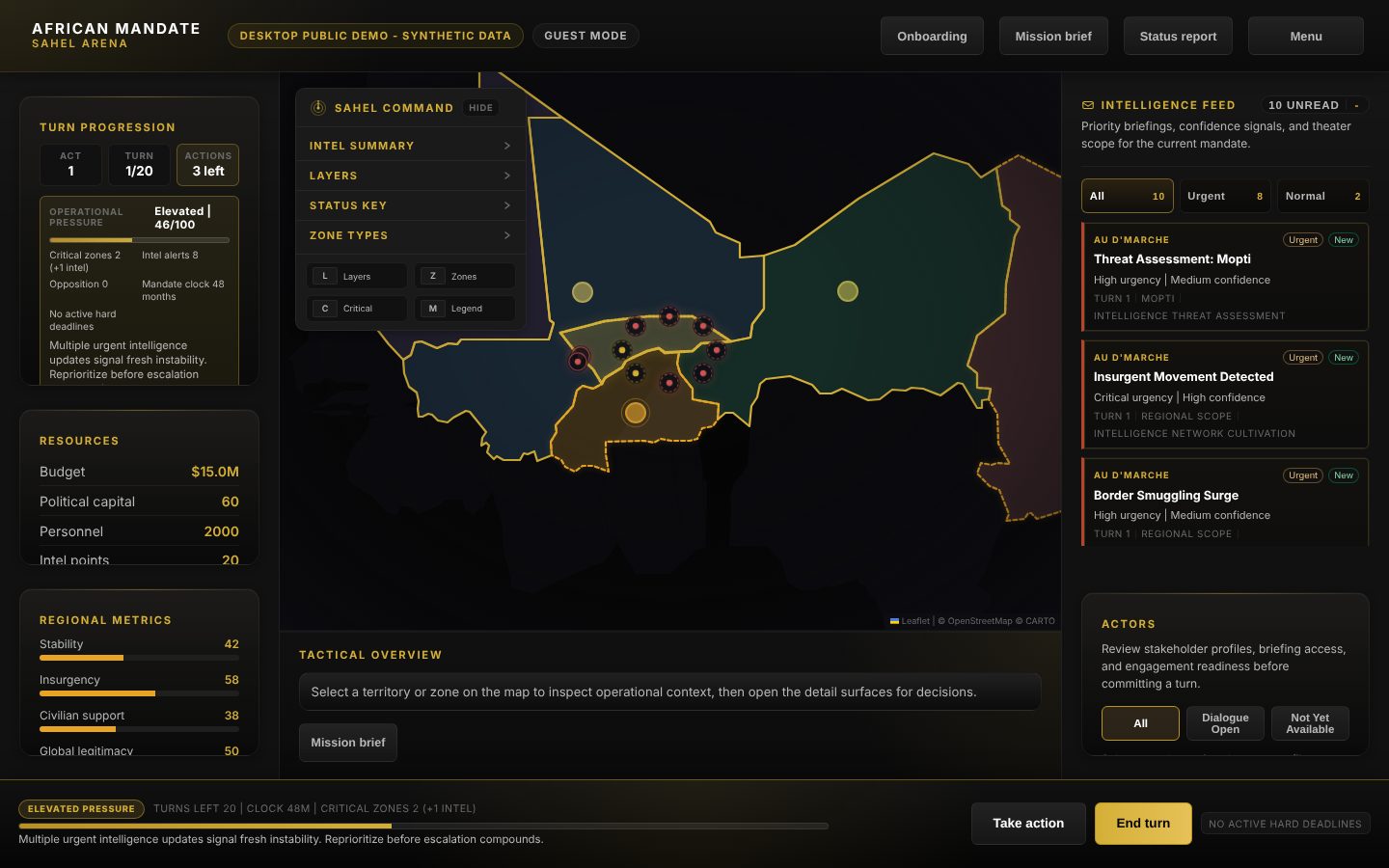
The player is the AU Special Envoy for the Sahel. |
| Three actions a turn |
Ruthless prioritisation. |
Budget, political capital and personnel are never enough for everything. |
| Five metrics that pull apart |
Trade-offs instead of a single objective. |
Stability, insurgency, civilian support, global legitimacy and regional synergy. |
| Confidence on every report |
Acting on imperfect intelligence. |
Each feed item carries urgency and confidence signals. |
| Evidence, conditions and knowledge kept apart |
Knowing what the model knows and what it assumes. |
In the RPG, observed data, latent scenario conditions and player knowledge are modelled separately. |
| Simulated actors, labelled |
Not mistaking a game for a forecast. |
In the RPG, fictional procedures and actor positions carry a visible “simulated” label, with no real person or asserted private intent. |
| Trajectory, not a score |
Judging a mandate by how it went, not by one number. |
The RPG weighs the end state at 40% and the trajectory at 60%, penalises prolonged crises and countervailing harm, and shows no overall score or leaderboard. |